
There is something almost unbearable about sunlight when your world is falling apart, something quietly cruel in discovering that catastrophe does not alter the appearance of things. In one of the most affecting moments of Adrian Goiginger’s Four Minus Three, Barbara is sitting in a car after learning that the bus carrying her husband and two children has been involved in an accident. She does not yet know that she is about to lose all three of them. As the car carries her towards the hospital, the road ahead is flooded with sunlight. Barbara’s life is about to change forever, while the world outside remains exactly as it was.
That image narrates much of what Four Minus Three is about. Based on the life of Barbara Pachl-Eberhart, the film is a story of terrible grief but also of the strange power of life to continue in its presence. Barbara returns to work, she laughs, she desires another person, and she discovers that her body can still respond to pleasure while she is grieving. None of this means that her loss is becoming smaller. The film skilfully depicts the uncomfortable possibility that grief and the desire to live can exist together.
This idea is especially powerful because laughter was already at the centre of Barbara’s life with Heli. Both were clowns. Barbara works as a hospital clown, while Heli, played by Robert Stadlober, wants to develop clowning as a stage art. Their family life is warm and playful, but not perfect. There are arguments about money, work and Heli’s ambitions. Goiginger allows us to see these tensions instead of creating an ideal family simply to make their deaths more tragic.
This moment becomes important when Barbara later speaks in church and refuses the perfect image of Heli that people have begun to create after his death. She loved him, but she also remembers the man who frustrated her and the difficulties in their marriage. She does not want death to make him better than he was. There is something deeply moving about this honesty: remembering someone truthfully, the difficult parts as well as the beautiful ones, can itself be an act of love.
The funeral is perhaps the film’s boldest expression of this idea. There are clowns, music, colour, balloons and people on stilts. Instead of standing quietly before death, people move.
Watching them, I thought of Nikos Kazantzakis’s “Zorba”. When experience becomes too overwhelming for words, Zorba dances. The body speaks instead. I felt something similar here. I wanted to dance with them. Not because dancing makes death less painful, but because sometimes grief is simply too large to remain still. The movement of the body becomes an affirmation that, despite everything, life is still there.
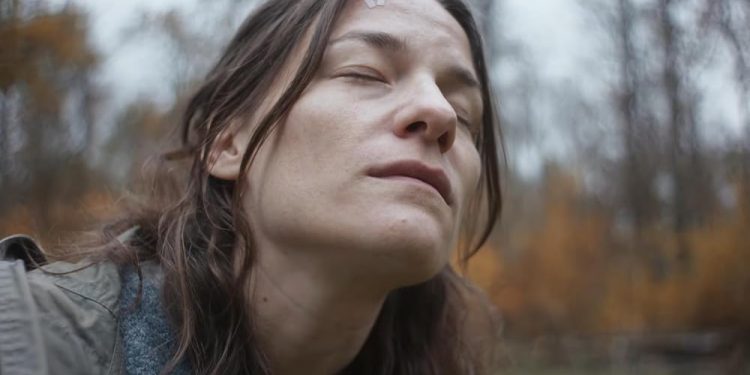
Valerie Pachner’s remarkable performance makes these contradictions believable. Her Barbara can be devastated in one moment and laugh in another without either emotion feeling false. At times she barely speaks, yet her face expresses everything that words cannot. There is no attempt to make her grief beautiful or predictable.
Paul Sprinz’s cinematography understands the importance of her face. His close-ups allow us to notice anxiety, exhaustion and the sudden arrival of laughter, sometimes separated by only a few seconds. The handheld camera adds another layer to this feeling. Before the accident, its movement belongs to the energy of family life; afterwards, the same movement feels less secure, as though the camera itself is trying to find its balance beside Barbara.
The film also moves between past and present without turning memory into a collection of perfect moments. Barbara remembers arguments as well as tenderness. Heli remains complicated in her memory, which is exactly why he remains alive as a character rather than simply becoming “the dead husband”.
One of the film’s most interesting moments comes when Barbara wants to return to work. For those around her, the idea of a mother who has just lost her children going back to a hospital to make other children laugh is difficult to understand. But for Barbara, clowning is part of who she is. Her decision also exposes how easily we create rules for grief: a grieving woman is expected to look and behave in certain ways, and laughter seems almost inappropriate.
The same discomfort appears when Barbara seeks physical intimacy and later begins a relationship with Friedrich, played by Hanno Koffler. Another man cannot replace Heli, and the film does not pretend that he can. What matters is something simpler: Barbara is still alive. Her body still wants warmth, touch and closeness. Life continues to make demands on her even while she is mourning.
This role is where the clown becomes more than Barbara’s profession. The clown falls, fails, looks ridiculous and rises up again. There is a kind of wisdom in that lack of control. Barbara cannot control what has happened to her, and she cannot turn the deaths of her family into something meaningful simply because a story needs meaning. She can only discover how to live inside what has happened.
At times, the enormous sadness of its story nearly overwhelms Four Minus Three. It is strongest when Goiginger does not push that sadness too hard and instead trusts Barbara’s contradictions. Pachner is crucial here. She never allows Barbara to become simply a symbol of grief; she remains a woman who can be frustrated, funny, sexual, exhausted and deeply wounded at the same time.
By the final balloon sequence, the film has not offered Barbara a simple recovery, and thankfully, it does not suggest that she has “moved on”. It does not suggest that she has “moved on”. She has simply found a way to continue without leaving the people she loved behind.
And perhaps that is why the sunlight at the beginning matters so much. At first it seems almost cruel: Barbara’s world is collapsing, and yet the day remains beautiful. But by the end, that same persistence begins to mean something else. Life continues without asking whether we are ready for it.
Barbara does not overcome grief to return to life. She carries her grief with her into life. And sometimes she carries it laughing.