
Children of the Monkey from Italy, directed and co-written by Tommaso Landucci was premiered at the Horizons section of the Venice Film Festival. From the viewpoint of someone who only watches those Italian movies shown outside Italy in cinemas and film festivals, the most popular Italian actors appear to be Riccardo Scamarcio, Pierfrancesco Favino and Toni Servillo. Scamarcio is perhaps the one most familiar to western audiences, from appearance in films such as John Wick: Chapter Two and A Haunting in Venice. Children of the Monkey provides Scamarcio with a role to really sink his tooth into. Sporting a very shot haircut, Scamarcio plays Dario. He and his wife’s only child is a boy born with physical and mental disabilities. In contrast, Dario’s brother, who is also his boss, has a very healthy teenage son. Dario used to participate in motocross bike riding competitions. Scamarcio offers another superb performance and with great skill through mainly facial expressions displays Dario’s frustrations with not being able to have what he hoped from a father-son relationship and coaching his son to learn bike riding. Instead, he uses his nephew as a surrogate son and takes him bike riding. He even pokes fun at his brother for buying his teenage son a bicycle for birthday present and buys his nephew motocross riding gear. His brother though wants his son to focus on his studies and initially doesn’t object to his brother’s increasing involvement with his son’s activities. However, both him and Dario’s wife lose patience with this situation, for different reasons. Director Tommaso Landucci refrains from any showy directorial gimmicks and instead lets the actors convey the emotional complexities of the screenplay to the viewers. Scamarcio and Landucci were awarded the Best Actor and Best Screenplay respectively.

No Paradise If You Are Killed by a Woman, written and directed by Halkawt Mustafa was shown out of competition at the Venice Film Festival. Viyan (Avan Jamal) is a Kurdish female sniper, known as Peshmergas, fighting ISIS, who are rampaging through Iraq and Kurdistan, killing men and taking women as slaves, either forcing them into marriages or selling them at auction. She is so deadly accurate in her shooting that she has become a legendary figure, known as the Swedish Sniper. Once Viyan’s tour of duty ends, she goes back to Norway where she has applied for asylum. However, when she learns that her younger sister is among the women captured by ISIS, she returns to Kurdistan to try to free her. In flashbacks we see the strong bond between the two sisters. According to Mustafa, the film is inspired by a true female Peshmerga sniper whom he met in September 2014 on the frontlines of the fight against ISIS in Mosul. No Paradise If You Are Killed by a Woman is by far the most exciting action movie that I have seen in the last few years. The direction, cinematography, editing, production design are world class and Avan Jamal’s is utterly convincing as the determined Viyan. The background to the film’s story, and the fact that it was filmed in the actual locations depicted in the film, demonstrates the hollow nature of most Rambo type action movies. I would not be surprised if Hollywood came calling for Halkawt Mustafa.

One Minute to Midnight had its world premiere in the Competition section of the Venice Film Festival. It is written and directed by Nicolas Pariser. Léo (Melvil Poupaud) lives in rural France, is about to hit fifty and is in the process of separating from his longtime partner. He finds out that his biological father, whom he never knew, had died in Italy and left him an inheritance. Before his trip to Italy to claim his inheritance, Leo decides to spend a few days in Paris and look up his daughter and a few old friends. We learn that in his younger days Leo was a journalist and started a magazine with some friends. One Minute to Midnight is mainly composed of a series of long conversations. The conversations, with his activist daughter Giulia (Chiara Mastroianni), Éléonore (Léonie Simaga), partner of a friend and friends and ex-colleagues are both engaging and revealing about the character of Leo and people in general. These conversations also display the impact of passage of time on feelings, attitudes and perspectives. The conversation between Leo and Éléonore, which takes place while they walk round a few blocks of apartments, is reminiscent of the walk and talk between Ethan Hawke and Julie Delpy in Before Sunset (2004). A character who pops up in conversations between Leo and his ex-colleagues is Tina (Golshifteh Farahani). She was the beautiful one in the office whom all the guys fancied. Now, after many years, and being in the process of being separated from his partner, Leo is very keen to re-connect with her and searches the city to find her. The question is whether a forty something Tina has the same characteristics and enigmatic qualities which cast a spell on her male colleagues? People change; Giulia has changed from a very young girl that Leo remembered to an activist woman. The years have also mellowed Tina. She no longer has those effervescence qualities that Leo remembered and desired. Pariser has tackled a subject which has given thoughts to many men and women in middle and old age, who are perhaps bored with their routine life and imagine themselves in their younger days and search for that young love that they had, not knowing what effect has the passage of time had on those they search for.

Children Untold, written and directed by Miwa Nishikawa, was shown in the Platform section of the Toronto International Film Festival. It covers a time and a place that I have rarely come across in movies; Japan immediately after the Hiroshima and Nagasaki atomic bombings. The film opens with two young girls taking piano lessons. The girls are reprimanded by the elders for playing enemy’s music when they play a Debussy classical piece. In quite an effective way we see the girls witnessing in the far distant an atomic explosion. We then move forward two or three months to November 1945. The two girls are separated at a train station. One of them is taken away by her parents but there’s no one at the station to collect the twelve-year old Kotoko (Ami Koyae). Her teacher Sone (Fumi Nikaido) offers to take her, but Kotoko stubbornly refuses, being adamant that her parents will turn up, sooner or later. Of course they don’t, presumably having been killed by the US bombings. We then follow what Kotoko and Sone experience in war torn Japan. It is an apocalyptic world filled with derelict buildings, hunger, homelessness, crime. Kotoko manages to find her brother, who is obviously suffering from PTSD and has become a heroin addict, leading to a predictable end for him. For her safety, Kotoko cuts her hair short and poses as a boy, joining a group of children turned into petty crime by a Fagin like character. Escaping that gang she turns into shoe polishing and witnesses girls her age or slightly order, selling their bodies for food. It is a depressing and demoralising environment, movingly depicted by Nishikawa and her cinematographer Norimichi Kasamatsu. Meanwhile, Sone is not faring much better. She is pregnant and no one wants to give a job to a pregnant woman. The Japan is divided into a country of haves and have nots. There were some unscrupulous people that by hoarding and speculating are becoming rich whilst others are begging in streets for food. We are told there were 120,000 war orphans in Japan. Add to this the war between Japan and Korea and one wonders how Japan recovered from the depth of misery and deprivation to become one of the most advanced industrialised nations. Children Untold is an eye opener which keeps the viewers fully engaged for all its 150 minutes running time.

Djinn Wedding written and directed by the Ferit Karahan from Türkiye also premiered at the Platform section in TIFF. It is set in Anatolia. Its setting immediately reminds one of Nuri Ceylan’s masterpiece, Once Upon a Time in Anatolia (2011). The word Djinn appears in the Quran. It is a supernatural being who can be both male and female. It is described as a supremely intelligent being who can both represent goodness & light and Satan and darkness. Its reference in day-to-day life among Muslims is mainly as a satanic creature. Karahan’s film deals a lot with beliefs derived from religion, tradition and superstition. The film is divided into three chapters: Angels, Djinns and Chains. Angels section deals with the childhood of four siblings. Djinn section is the end of childhood innocence and beginning of adulthood with its accompanying moral complexities. In Chains section, all the elements come together. Memory also plays an important part in this story of four siblings. All these elements are featured in the central wedding section, with an Imam representing religion and the groom’s family focused on tradition and superstition. A key scene is the wedding night. The groom’s family, though not the groom himself, are determined that the bride must be a virgin before the wedding can be consummated. They wait outside the married couple’s bedroom to inspect the bedsheets for blood assuring them of the bride’s virginity! Djinn Wedding is full of haunting images which help to convey the barriers put up by religion, tradition and superstition, which bring a darkness to the life of the main protagonists in the story.

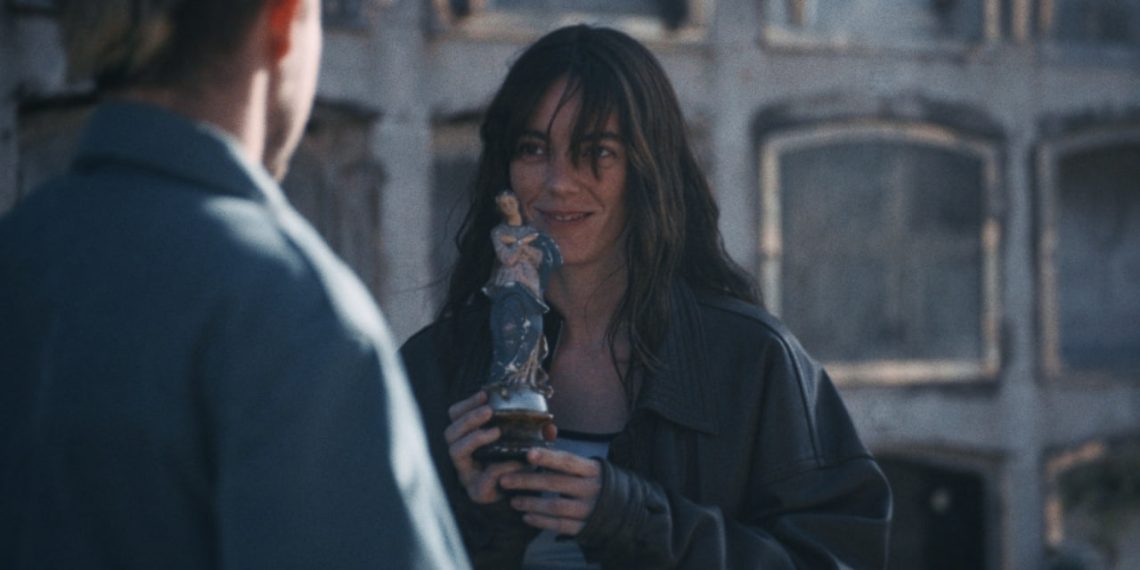
Saints directed by the Spanish director Mikel Gurrea, premiered at the Main Competition section of San Sebastian International Film Festival. Lali (Victoria Luengo) is a petty thief and pickpocket. She lives with her mother Glòria (Ariadna Gil), a terminally ill woman who has resorted to praying and hoping that her religious devotion will result in a miracle cure. Lali is very close to her mum, and her wellbeing is her prime worry. Lali joins a gang who steal valuable statues and artefacts from churches. An act which seems to be in direct contrast to her mother’s religious beliefs. Lali develops a close bond with the gang’s leader Rosario (Eulàlia Ramon), who becomes like a surrogate mother to her. Gurrea instils more tension and suspense in the film with each theft which become increasingly more audacious. Our expectation is that these acts are bound to have an adverse effect on Glòria’s health, but we are in for a surprise. Mikel Gurrea seems to be asking whether these religious artefacts serve a better purpose by adorning churches or be sold and their proceedings go to help the poor and sick, like Glòria? Most of us are conditioned by our environment, upbringing and whatever religious beliefs we tend to feel abhorrence at these thefts. That seems to be exactly what Gurrea intended and left it to the viewers to look at the situation of people like Lali and Glòria and make an impartial judgement.
