
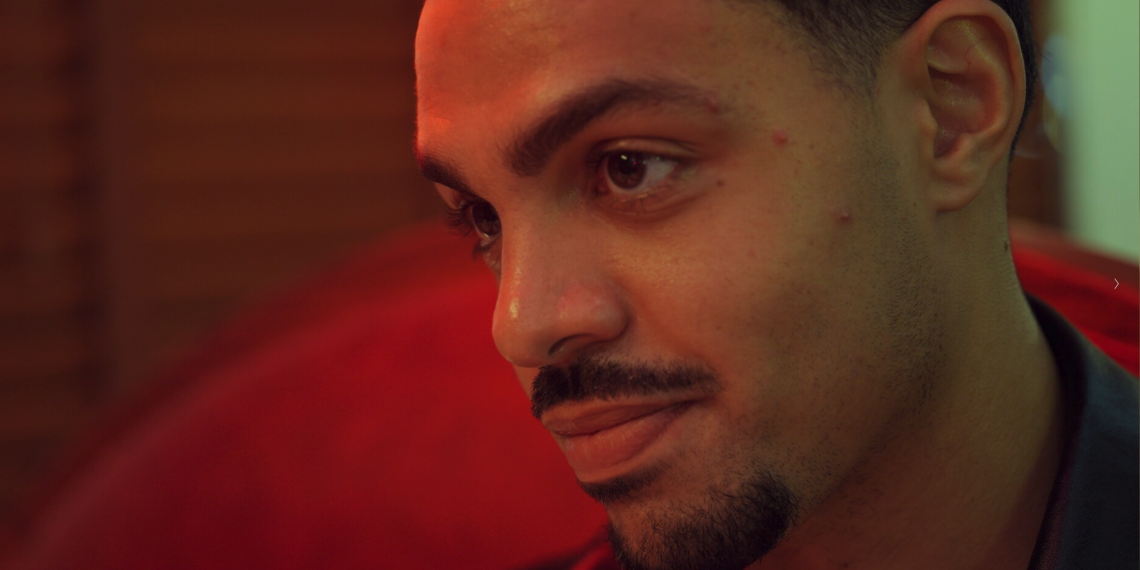
In Something Else Tonight, filmmaker Tyler Brooks ventures into the delicate territory where romance meets danger. Described by its creator as a “dark rom-com,” the film blends the emotional spark of a chance encounter with the mounting paranoia of a crime thriller. At its center is Cade, a contract killer whose rigid, mechanical life begins to fracture during what appears to be an ordinary date—until the evening reveals itself as something far more sinister.
With stylized nighttime visuals, a carefully crafted color palette, and philosophical undertones drawn from thinkers like Nietzsche, the film explores loneliness, moral ambiguity, and the fragile boundary between fate and choice. Brooks, collaborating closely with cinematographer Reneil Alcordo, constructs a cinematic world where the glow of romance and the shadow of violence coexist in uneasy harmony.
In this conversation, Brooks reflects on the creative risks behind his debut narrative project, the symbolism woven through the film’s biblical references and philosophical ideas, and the performances—especially Sarina Freda’s layered portrayal of Billie—that anchor the film’s shifting emotional landscape. The result is a story that invites audiences to question whether Cade’s tragic fate is the product of manipulation, destiny, or the quiet but decisive choices he makes along the way.
You’ve described Something Else Tonight as a “dark rom-com.” What initially drew you to blending the spark of a boy-meets-girl story with the paranoia of a crime thriller, and how did you balance those two tonal extremes without one overpowering the other?
My initial idea for the film was something much more comedic and light-hearted – a guy on a date with a girl, where in the middle of the date, he realizes he doesn’t have enough money to pay for it. There would be a lot of stalling, texting friends to see if they could send him cash, etc. I’m a big fan of crime thrillers as well, and I thought, “what’s something more intense a guy could realize on a date?” I arrived at the conclusion of, he’s a hitman, and he has to kill his date. The whole idea blossomed from there.
Dubbing the film our “dark rom-com” and speaking about it that way helped me to do just that; to balance both tones while not having one take up more space than the other. Throughout the time I spent writing the film, planning the visuals and aesthetic with my creative partner, Reneil Alcordo, and speaking with my lead actress, I wanted to make sure we knew exactly what we were going for. The idea of juxtaposing the lovey-dovey-ness of a romcom with the grit and suspense of a thriller was super interesting to me, and wanted to do our best to hold both of those ideas hand-in-hand the whole time.
Cade begins the film as a mechanically obedient contract killer, yet by the diner scene he reveals a fragile loneliness. How did you approach shaping his emotional arc so that his decision not to kill Billie feels both surprising and inevitable?
The idea behind this is that Cade is such a mechanical, by-the-book killer exactly because he is so lonely. This persona he’s built up is there to distract himself, and others, from the fact that he feels so alone, to the point he doesn’t even realize this himself. When Billie cuts right through this, both with her words, and with the gentle touch of her hand, it breaks down Cade’s walls in a way he hadn’t even remembered was possible. He doesn’t know the last time anyone has truly seen him, and the fact that she does, even if her intentions are malicious, fundamentally changes something in Cade’s mind.
Billie is written as both romantic interest and calculated avenger. At what point in the writing process did you decide that she would ultimately outmaneuver Cade, and what did you want audiences to feel in that final reversal?
Billie was always going to outmaneuver Cade. I wanted the audience, much like Cade, to be caught in her trap. She’s a charming, charismatic woman, played brilliantly by Sarina Freda, who can make you let your guard focus just long enough for her to strike. She knows she’s going to kill Cade before he knows she exists. I hope the audience is surprised, but also has a healthy dose of “I should have seen this coming all along.”
The names “Adam” and “Eve” clearly evoke biblical imagery. How intentional was this symbolism, and what does it add to the film’s exploration of fate, temptation, and moral consequence?
It was very intentional, and worked a couple different ways. Cade and Smithson definitely had to use coded language to talk about their criminal activity, and I liked the idea of Cade’s killings being “deliveries,” almost to suggest he was doing them a favor. Perhaps in his mind, he was. But delivering the “apple,” to Adam & Eve, the apple in the Bible being from the tree of the knowledge of good and evil, ties into the ideas Cade ponders stemming from the book he’s reading, Nietzsche’s “Beyond Good and Evil.” To him, killing isn’t moralized, isn’t a divine wrong, it’s just an act – he is beyond good and evil.
I also toyed with the idea of Cade acting as the angel of death, merely the messenger carrying souls to the beyond – after all, it isn’t his own will he’s enacting, he’s simply going where he’s told, killing who others want dead.
Then, maybe the most obvious connection, as you mentioned, was the idea of temptation. In the Bible story, Adam and Eve know they should not eat the fruit, yet they do it anyway, and this leads to their fall from grace. Cade knows he should not entertain this strange but intriguing young woman on the train. When he discovers who she is, knows that, according to his own code, he should kill her. But he goes against what he knows, and meets his doom because of it.
This is your first narrative project, as well as Reneil Alcordo’s debut as Director of Photography. How did that shared sense of “firsts” shape the creative risks you were willing to take, especially in crafting such a stylized nighttime filmscape?
In a sense, because it was both of our firsts, we felt a lot of creative freedom. While we wanted to get everything right and put in a lot of hard work to ensure we did, we didn’t have anyone overseeing us telling us what decisions to make, or telling us “no one does it like that,” and we didn’t feel super beholden to proving our techniques to anyone else. We snuck drone shots of the city when we could, we shot around people on the train (also got super lucky that everyone just happened to clear off the train in the middle of our scene there). Don’t get me wrong, I studied extensively, I read every book on directing I could get my hands on, I leaned heavily on my memory and experiences of other sets I’d been on as an actor. But when it came down to it and we got on set, we just did what felt right. While not having experience with cinematic lighting, Reneil is an expert at creating a beautiful image both in-camera and in post production. I had a very specific visual style I wanted to embody, inspired by other films I really love, and we were able to combine our talents to make something really fun and special.
The film places strong emphasis on color grading, city lights, and atmosphere. Can you talk about how the visual language—particularly the influence of directors like Park Chan-Wook, Wong Kar-Wai, and Matt Reeves—helped express loneliness and romantic tension simultaneously?
Absolutely. The nighttime cityscape, the colors, the lighting, as well as the music, were super important to us from the jump. The three directors mentioned were a big influence on this film aesthetically; I love the way their visuals set the tone and create a fully realized world for us to inhabit with the characters as soon as we see it, without even knowing anything about the plot. The color red in particular was a north star for us, as it symbolizes not only intense, blossoming love, but grave danger. Both central themes of this story. My colorist, Reneil Alcordo, deserves all the praise for this. I described to him the tone we were going for, and he executed it to perfection.
The incredible original score composed by Scott Johnson is also instrumental (no pun intended) in constructing the feel of this film. This is especially true at the very end of the film. I specifically wanted to juxtapose the violence and tragedy that occurs with the romantic feel of “and they lived happily ever after.” Hence, the lovey-dovey score that plays as Cade is bleeding out and Billie gingerly leaves him there to die.
Sarina Freda’s performance as Billie carries a delicate duality: warmth and manipulation. What conversations did you have with her about maintaining that balance, especially knowing the audience would re-evaluate her character after the twist?
Sarina is incredibly talented, and she brought so many ideas and choices with her after just reading the script, I felt like I hardly had to direct her. We had a few very brief rehearsals before shooting where we spoke about crafting the characters. One thing I told her in particular was to think of Billie as an anglerfish, shining a beautiful light in the darkness of the sea to lure her prey close so she can go in for the kill. Billie knows what she’s doing the whole time – she charms Cade, says what she knows he needs to hear to let his guard down around her, and sweetly, kindly leads him to the place she’s going to kill him. We had a lot of fun playing as these characters, and Sarina was such a natural; it was like Billie leapt off the page into real life.
The text messages from Smithson function almost like an invisible antagonist pressing in on Cade’s autonomy. How did you conceive of Smithson’s presence as both a narrative device and a symbol of external Control?
The text messages from Smithson function in two ways. One, it’s to emphasize a point that Cade makes in the diner to Billie, that he enjoys his job because he’s great at executing, that he doesn’t have to think about or plan anything because it’s done for him. Even more than a hitman, Cade himself is a weapon. The text messages are the trigger. He just needs to be pointed in the right direction. This is how he conceives of himself, anyway. The other way is to show that even with the carefully curated persona Cade has built himself, he is not in control of his situation. “Smithson” is the puppetmaster, the orchestrator of his life. There’s always an external force guiding his path, no matter how much he thinks he “trusts himself” or tries to philosophize the choices he’s made. In a sense, he’s given up his autonomy, had relinquished control even in trying to gain it. Throughout the course of the story, the role of the puppetmaster transfers from Smithson to Billie, whose game Cade does not even know he’s playing.
The film suggests that one small decision can alter the course of a life. In Cade’s case, it’s agreeing to dinner. Do you see this story as a meditation on destiny, free will, or the illusion of choice?
It’s definitely an expression of the idea that even if or when outside forces are at play, the choices we make can have grave consequences either for or against us. I mentioned early how Smithson and his texts represent an outside entity pulling the strings in his life, and how Cade quickly falls into the clutches of another person, Billie, who functions similarly. However, even while playing their game, Cade has agency. He could have chosen not to go where Smithson sends him; could have chosen not to go have dinner with Billie; could have even chosen to go through with Smithson’s text and kill her’ or he could have walked away from the entire situation. Others were manipulating the situation, but Cade willingly walked into his own demise.
With six festival selections already for your debut narrative project, how has the early reception—especially audience reactions from screenings and platforms like Letterboxd—shaped your understanding of how viewers interpret the film’s moral and romantic ambiguities?
The early reactions have been wonderful. Ultimately, our only goal with this film was to make something we were proud of, which we did. Everything else is icing on the cake. But we’ve been super fortunate to be able to share it with others, and to play our film in a real movie theater was such an exciting experience. We’re super happy people are having fun with it and giving it good reviews, hearing the gasps and the collective “Oh no!” at the reversal at the end of the film has been incredibly fun. The question about balancing the genres/tones of the romance and the paranoia of a thriller is actually one we’ve gotten quite a bit. Another comment/debate we’ve been hearing from audiences is whether or not Cade should have killed Billie in the diner when he found out who she was, some people saying he should have, others saying that if they were in his position in that moment, they would’ve done what he did. So we’re really glad people are engaging that tension and towing the line with us.